Rachel Scott: New York’s Newest Vanguard
How the Diotima founder and newly appointed Proenza Schouler Creative Director is reshaping American fashion.

Image: BOF
The Season’s Quiet Revolution
After a whirlwind of a season, and perhaps the most dramatic game of musical chairs fashion has seen in years, it feels as if we’ve all been seated at one very crowded table. It was Rachel Scott who reminded everyone why New York Fashion Week still matters.
The Jamaican-born designer, celebrated for her label Diotima, has now stepped fully into the spotlight as the new Creative Director of Proenza Schouler, following the departure of founders Jack McCollough and Lazaro Hernandez to Loewe. “There’s a beautiful legacy here. I think it has to move forward,” Scott said — a quiet declaration that inheriting a house with history doesn’t mean silencing your own vision.
Diotima: Craft as Liberation
Before Proenza, there was Diotima, a label that has, in just a few years, redefined the visual and emotional language of American luxury. Her world is one built from texture and tension: crochet lace meets tailored shirting; handwoven latticework is offset by urban structure. Her aesthetic is deeply personal, grounded in her Jamaican upbringing and the celebration of Carnival, a festival that emerged from emancipation and the reclamation of joy. In her show notes, she wrote that the collection drew upon “the music, dance, costume, food, and revelry of mixed Caribbean and African cultures.” Through Diotima, Scott turns craftsmanship into a form of liberation—every loop, weave, and drape a gesture of identity made visible.
A Show That Moved the Room
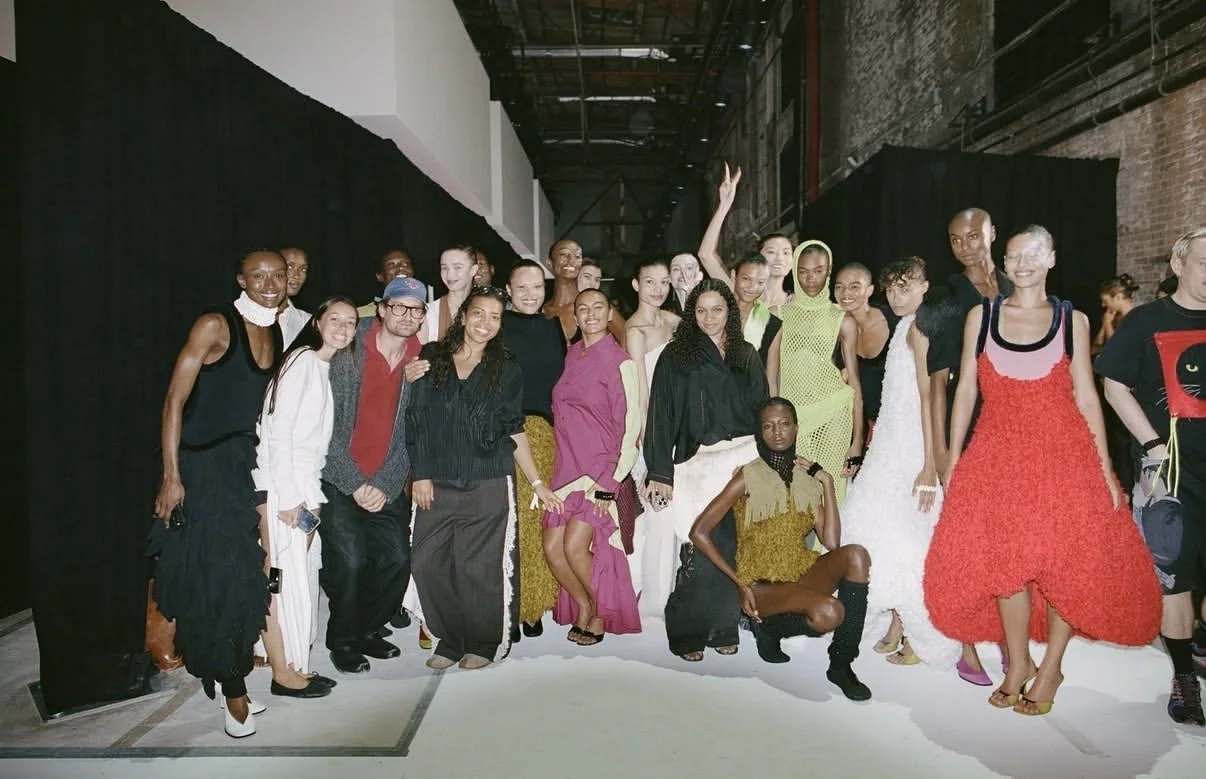
Her runway debut took place in an industrial gallery space in Greenpoint, a location donated by the team at COS, and drew a packed crowd that included Eva Chen, Willy Chavarria, and Christopher John Rogers. The energy in the room made it clear: Scott’s world is one people want to be part of.
As she told Vogue Runway, last season she was “still angry.” This time, that emotion transformed into something more layered: “We’re living in America and I’m still extremely angry, but the manifestation of this anger is different… and coming across much more rebellious.” Carnival, she said, was a moment of resistance—“one that’s very subversive, very exuberant, and sensual. It’s undefinable.”
And so is Diotima itself: sensual, subversive, exuberant, undefinable. A tailored jacket cut close to the body. A fluorescent pink skirt with a sheer blue cummerbund. A pencil skirt wrapped in shirred tulle. Each piece holds the tension between elegance and rebellion, between what is seen and what is felt.
At a time when fashion seems to be backsliding on inclusivity, Scott’s casting across both her Diotima and Proenza Schouler debuts felt radical in its simplicity. Models of every size and shade walked her runways, a vivid reminder that luxury can, and should, reflect the full spectrum of beauty.
Proenza Schouler: A Legacy in Transition
Scott’s appointment at Proenza Schouler is less a replacement than a renewal. She steps into a brand synonymous with technical refinement and modern minimalism, a house built on sharp tailoring and quiet confidence, and infuses it with something deeply human. “There’s a beautiful legacy here,” she said, “but it has to move forward.”
At 41, she’s not a newcomer, but an industry veteran with nearly two decades of experience at Costume National, J. Mendel, Elizabeth and James, and Rachel Comey. Her sensibility bridges precision and emotion, logic and instinct—the very duality that has long defined American fashion at its best. If Diotima is her act of reclamation, then Proenza Schouler is her act of evolution. It’s where technique meets tenderness, where the rigor of design coexists with cultural storytelling.

A New Definition of American Fashion
To watch Rachel Scott right now is to watch the center of gravity in New York fashion shift. Her presence signals a new kind of authority—one rooted in sincerity. With so much noise in the world, it feels vital to recognize the importance and rarity of designers like Scott, who remind us that beauty and purpose can coexist. Few designers can command two worlds at once. Scott does — and with clarity. Two runway debuts in one season don’t mean she’s splitting herself in two; they prove she’s expanding the boundaries of what a designer can hold and do.
Named after Diotima of Mantinea, the prophetess who taught Plato about Eros—the ascent from desire to spirit—Scott’s label embodies that same evolution. Love, she believed, was never simply beautiful or good; it was layered, imperfect, and transcendent. In Scott’s hands, fashion becomes that same act of pursuit: a striving toward something felt rather than defined.
Rachel Scott is more than a designer; she’s a philosopher of form. Her vision bridges worlds—craft and intellect, rebellion and restraint, Jamaica and New York—and her rise marks a turning point for American fashion. At a moment when the industry is searching for meaning beyond the spectacle, Scott reminds us that clothes can still speak truth, that artistry can still be radical, and that beauty, when born of conviction, can move culture forward.